











Blog



Traditional credit scoring methods relying solely on credit bureau data and manual analysis no longer meet modern business demands. AI credit scoring has transformed risk assessment by processing vast amounts of data in real-time, identifying patterns human analysts might miss.
The shift toward automated systems addresses competitive pressures where quick credit assessment while minimizing bad debt determines profitability. Modern credit scoring software provides audit trails, explainable AI outputs, and compliance features that manual systems cannot deliver consistently.
Credit bureaus provide baseline information but lack nuanced understanding of your specific customer relationships. Your business possesses unique data credit bureaus never see payment reminder responses, communication patterns during disputes, seasonal trends, and product-specific track records.
Internal credit scoring allows weighting factors according to what predicts payment behavior in your customer base. Credit bureau reports update monthly or quarterly, creating costly information lag. They also don’t see all the information related to you. Your internal system incorporates yesterday’s missed payment or today’s dispute, providing dynamic risk assessment reflecting current reality.
This approach enhances rather than replaces credit bureau data. The most effective strategy combines external reports with internal scoring, creating comprehensive views leveraging both broad financial context and specific relationship insights.
The best credit scoring tools share essential capabilities:
Predictive AI and Machine Learning: Algorithms continuously learn from payment outcomes, refining accuracy over time. These systems identify subtle risk patterns across thousands of variables, forecasting when and why defaults might occur.
Customizable Scoring Models: Modern tools let businesses define risk parameters, weighting factors according to industry-specific payment predictors rather than forcing conformity to rigid criteria.
Real-Time Data Integration: Instant information pulls from ERP systems, CRM platforms, payment processors, and credit bureaus create up-to-the-minute risk assessments.
Automated Workflow Triggers: Systems automatically execute predefined responses based on score changes, placing orders on hold, triggering collection workflows, or alerting managers without manual intervention.
Comprehensive Analytics: Dashboards visualize portfolio risk distribution, track scoring accuracy, and provide drill-down capabilities to understand score drivers.
Seamless Integration: Connection with A/R automation software and cash application software eliminates data silos.
Compliance Features: Transparent documentation of score calculations, decision rationales, and change tracking supports audits and regulatory requirements.
Gaviti is a comprehensive accounts receivable platform with sophisticated credit scoring for B2B businesses. Unlike standalone tools, Gaviti integrates credit risk assessment into the complete A/R workflow.
The credit scoring engine combines credit bureau data with internal payment behavior analytics, creating dynamic risk profiles updating in real-time. Gaviti’s predictive AI analyzes payment patterns, communication responsiveness, and dispute history to forecast payment probability.
Scores automatically trigger appropriate workflows. High-risk customers receive proactive outreach before invoices become overdue. The system automates the collection process to eliminate manual tasks, ensuring consistent follow-up calibrated to risk levels.
Extensive integration with major ERP systems, accounting platforms, and credit bureaus creates a unified credit intelligence source. The dashboard provides portfolio-level risk visualization alongside individual customer insights.
Experian brings massive credit data repositories into business-focused scoring. The platform offers comprehensive credit reports, continuous monitoring, and industry peer benchmarking.
Strength lies in data breadth, databases contain information on millions of businesses, providing context internal data cannot match. Scoring models incorporate trade payments, public records, financial statements, and industry risk factors.
It should be noted that Experian primarily delivers external perspective. While excellent for initial evaluations and credit bureau monitoring, it lacks internal payment behavior integration. Organizations typically use Experian alongside internal systems.
D&B’s platform leverages the DUNS number system and extensive commercial database for detailed risk assessments. Paydex scores and credit ratings offer widely recognized creditworthiness benchmarks.
The platform provides predictive indicators including failure scores estimating business closure or bankruptcy probability within 12 months. Industry-specific models account for sector-specific factors.
Like Experian, D&B excels at external intelligence but requires internal data supplementation for complete visibility.
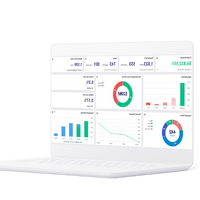
You’ve seen the best credit scoring tools — now see how teams act on them
See It in ActionCreditPoint offers dedicated credit management for mid-market and enterprise businesses, combining automated applications, scoring workflows, and account monitoring.
Customizable scoring models allow businesses to define risk parameters incorporating external credit data and internal payment history. Workflow automation routes applications through appropriate approval chains.
Integration with major ERPs enables real-time credit holds and release decisions. CreditPoint works well for organizations seeking to automate credit scoring process workflows.
HighRadius delivers enterprise-grade credit management powered by AI. The Credit Cloud analyzes payment behavior, financial health, and external data for comprehensive risk scores.
Predictive analytics identify customers likely experiencing payment difficulties before problems emerge. Automated workflows route high-risk accounts through enhanced reviews while fast-tracking low-risk approvals.
HighRadius excels in large enterprises with complex hierarchies and high transaction volumes, though complexity and pricing exceed smaller organization reach.
Tesorio focuses on cash flow intelligence, incorporating credit scoring within broader cash forecasting and A/R optimization. Machine learning algorithms analyze payment patterns to predict which invoices will be paid when.
Strength lies in predictive payment date estimates combining credit risk with cash flow forecasting. This helps businesses optimize working capital by understanding payment timing from reliable customers.
Seamless integration with accounting systems and ERPs automatically pulls invoice and payment data. Collaboration features enable collections teams to coordinate using AI-driven prioritization.
Creditsafe delivers global business credit information across 160+ countries, valuable for international customer bases. The platform provides credit scores, reports, and monitoring with particular European and Asian market strength.
Real-time credit limit recommendations adjust automatically based on changing financial circumstances. Monitoring services alert users when customers experience significant credit events.
API integration enables embedding credit checks directly into sales, order management, or onboarding workflows.
Implementing credit risk management tools requires measuring quantitative impact:
Days Sales Outstanding (DSO): Average time between invoice and payment. Effective scoring reduces DSO by identifying high-risk customers requiring proactive management.
Bad Debt Write-Off Percentage: Total write-offs as percentage of credit sales. Strong scoring reduces this by preventing credit extension to unlikely payers.
Credit Decision Turnaround Time: How quickly applications move through processes. Automation dramatically reduces approval times for low-risk customers.
Collection Efficiency: Percentage of receivables collected within terms versus requiring collection efforts. Effective scoring focuses resources on accounts needing attention.
Prediction Accuracy: For high-risk customers, what percentage experienced payment problems?
Manual Workload Reduction: Hours freed from manual analysis. Many organizations achieve 60-80% reductions in routine credit administration time.
Selecting credit scoring tools requires aligning capabilities with business context and objectives:
Define Clear Requirements: Document what credit scoring must accomplish, reduce bad debt, accelerate approvals, free staff time, or improve cash flow predictability. Create weighted scorecards for objective comparison.
Assess Integration: Evaluate connections with your ERP, accounting software, and CRM. Pre-built connectors dramatically reduce implementation time versus custom API development.
Evaluate Data Requirements: Some tools require extensive historical data while others incorporate external credit data to supplement limited internal information.
Consider Scalability: Ensure solutions accommodate future growth in customer count and transaction volume.
Test Scoring Transparency: Prioritize tools providing clear factor breakdowns showing score drivers. This proves essential for defending decisions and training staff.
Conduct Proof of Concept: Request pilot programs using actual data. Hands-on testing reveals usability issues and accuracy questions sales demonstrations miss.
Gaviti has emerged as the preferred choice for comprehensive accounts receivable management with integrated credit intelligence.
Unified Platform: Rather than separate systems for scoring, invoice delivery, collections, and cash application, Gaviti provides integrated functionality. Credit scores automatically inform collection strategies. CreditSafe integration provides a comprehensive risk assessment that takes internal behaviors into account as well as typical external factors that determine a traditional credit score.
Proprietary AI: Machine learning algorithms analyze your specific payment patterns and business cycles, creating customized risk predictions that continuously refine accuracy.
Real-Time Adaptive Scoring: Scoring updates continuously as new information emerges, early payments, disputes, or behavior changes immediately recalculate risk and adjust workflows.
Action-Oriented Intelligence: Automatic execution of appropriate responses based on risk levels, escalating collections, releasing orders, and optimizing communication frequency without manual monitoring.
Portfolio Optimization: Strategic analytics reveal portfolio composition, identify risk trends, and quantify credit policy financial impacts for data-driven decisions.
Implementation Simplicity: Modern architecture enables rapid deployment with pre-built integrations, achieving productive use within weeks rather than quarters.
Credit scoring software are digital platforms evaluating customer creditworthiness using algorithms and data analysis. These tools assess payment likelihood by analyzing financial history, payment patterns, and risk indicators. Modern solutions automate the entire credit evaluation process from application through ongoing monitoring, replacing manual spreadsheet-based assessments.
Credit scoring software delivers consistent, objective assessments faster than manual processes while analyzing more data points than humans can practically consider. Automation eliminates subjective bias, reduces approval times from days to minutes, and frees staff for strategic work while continuously monitoring all customers simultaneously.
AI analyzes thousands of variables and complex patterns that traditional systems miss, continuously learning from payment outcomes to refine predictions. Machine learning identifies subtle early warning signs across vast datasets, adapting to changing economic conditions and customer behaviors automatically, achieving significantly higher prediction accuracy than static models.
Essential features include customizable scoring models, real-time data integration with ERP and accounting systems, predictive AI that continuously improves, automated workflow triggers, comprehensive analytics for portfolio management, transparent scoring explanations, and seamless connectivity with broader A/R automation platforms for complete receivables management.
Select software by defining clear objectives, evaluating integration with existing systems, assessing data requirements and scalability, examining customization flexibility, and testing with actual data through pilots. Consider total ownership costs beyond subscriptions, including implementation and training. Prioritize solutions providing scoring transparency aligned with growth trajectory.
A/R software credit scoring incorporates internal payment behavior, communication patterns, dispute history, and relationship-specific factors that credit bureaus never capture. Internal scores update in real-time based on current account activity, while bureau scores typically refresh monthly, applying industry-specific weighting customized to your business logic.













Link is copied!
Contact us!
Welcome back