











Blog



Days Sales Outstanding is one of the most closely watched metrics in A/R. When DSO climbs, working capital tightens, forecasting becomes harder, and the pressure on collections teams increases. Most finance leaders know this but fewer recognize how much their credit management process is contributing to the problem.
Traditional credit management was built for a slower, more predictable business environment. Today’s A/R teams are dealing with customers across geographies, industries, and risk profiles, often with manual workflows that haven’t kept up with the complexity. The result is slow credit decisions, reactive risk monitoring, and collections efforts that start too late.
Agentic AI changes the equation. By deploying AI agents in finance that can assess risk, make decisions, and act autonomously, companies are cutting DSO meaningfully not through better spreadsheets, but through a fundamentally different approach to credit operations.
The gap between when an invoice is issued and when it’s paid is rarely random. In most cases, it traces back to decisions made much earlier in the customer relationship specifically, at the credit assessment stage. It could also be a result of not understanding their customer’s processes and voice payment habits.
Traditional credit management processes share a few structural problems that work against fast collections. Credit decisions are made manually, relying on analysts reviewing bureau reports, payment history, and financial statements on a schedule rather than in real time. This means a customer whose risk profile deteriorated last month may still be operating on credit terms approved six months ago.
Monitoring is similarly periodic. Most teams review credit limits on a quarterly or annual basis, which creates significant blind spots. By the time a high-risk account is flagged, a company may already have several overdue invoices.
Static credit policies are another issue. Rule-based systems can’t account for context. A long-standing customer with a temporary cash crunch and a new customer with a spotty payment history might be treated identically under a one-size-fits-all credit model. That lack of nuance leads to both over-extension of credit to risky accounts and unnecessary friction with reliable customers.
The downstream effect of all this is predictable: invoices go out to accounts that weren’t creditworthy to begin with, or accounts whose risk shifted without detection.
The term ‘automation’ gets applied to almost everything in finance technology, but agentic AI is meaningfully different. Standard credit automation follows fixed rules: if a customer’s credit score drops below X, reduce the limit to Y. It’s reactive and binary.
Agentic AI for credit operates differently. AI agents for credit risk are autonomous systems that can perceive data from multiple sources, reason about risk, make decisions, and take action, all without waiting for a human to initiate each step.
In credit management, this means the system is continuously pulling in data: payment behavior, bureau signals, industry news, ERP transaction history, communications patterns. It’s analyzing that data against dynamic risk models, not static thresholds. And it’s acting on its analysis — adjusting credit limits, flagging accounts for review, triggering collections workflows, or escalating to a credit analyst when a situation genuinely warrants human judgment.
The practical difference shows up in speed and accuracy. A credit application that previously took a day or two to evaluate can be assessed in minutes. An account showing early signs of distress can be flagged and acted on the same day not wait for the next quarterly review.
This is also where the comparison to rule-based automation matters most. Agentic systems learn from outcomes. If a certain combination of signals consistently precedes late payment, the model refines its weighting accordingly. The credit operation improves over time without requiring manual reconfiguration.
Dimension |
Traditional Credit Management |
Agentic AI Credit Management |
| Decision Speed | Hours to days (manual review) | Seconds to minutes (real-time) |
| Monitoring Frequency | Periodic: monthly or quarterly | Continuous, 24/7 automated |
| DSO Impact | Reactive limited reduction | Proactive measurable DSO reduction |
| Objectivity | Influenced by analyst judgment | Data-driven, bias-free decisions |
| Manual Effort Required | High, analysts handle most tasks | Low, agents handle routine work |
One of the most significant advantages that AI agents for credit risk bring to A/R operations is continuous monitoring. Instead of reviewing accounts on a fixed schedule, AI agents watch for signals constantly and respond when those signals indicate risk.
What does that look like operationally? An AI agent might detect that a customer who typically pays within 30 days has started paying at 45 days over the last two billing cycles. Simultaneously, it notices that the customer’s industry is showing signs of stress in public financial news. The agent doesn’t wait for the next monthly review, it immediately adjusts the customer’s internal risk score, flags the account for a credit analyst, and may reduce the available credit limit automatically based on predefined parameters.
This kind of early intervention is exactly what keeps DSO from escalating. When risk is caught early, collections outreach can begin before invoices age significantly. Credit terms can be adjusted before additional exposure is created. And in some cases, proactive outreach to the customer asking whether they’re experiencing cash flow issues can surface a problem that’s resolved quickly rather than becoming a write-off months later.
Real-time AI credit decisioning also removes the variability that comes with human judgment. Two analysts reviewing the same customer profile might reach different conclusions. An AI agent applies the same model consistently across every account, every time without fatigue, bias, or variance.
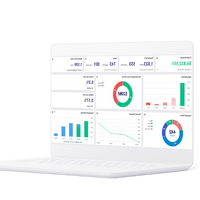
Discover faster, smarter credit decisions → Take a 2-Min Tour
See Product DemoThe impact of agentic AI in fintech extends across the entire credit lifecycle, not just the initial application decision. This end-to-end coverage is what makes the DSO reduction meaningful and sustainable.
At the front end, AI agents evaluate new credit applications in real time. They pull bureau data, cross-reference internal payment history from existing relationships, assess industry risk, and produce a credit recommendation including suggested terms and limits in a fraction of the time a manual review would take. High-volume B2B operations that process dozens or hundreds of credit applications per week can scale this process without adding headcount.
During the customer relationship, AI agents manage ongoing credit monitoring and limit management. They respond dynamically to changes in customer behavior or external risk factors, keeping credit exposure aligned with actual risk rather than with the snapshot taken during the original application.
At the collections end, agentic systems integrate with A/R workflows to ensure that accounts flagged as high-risk receive earlier, more targeted collections outreach. Rather than waiting for an invoice to age into the 60+ day bucket, the AI agent can trigger a gentle reminder at 15 days, an escalation at 30, and a credit review at 45 all automatically, based on the customer’s individual risk profile and payment history.
This full-cycle approach is what separates agentic AI from point solutions. The credit decision and the collections workflow are connected informed by the same data, operating under the same risk model.
For agentic AI to work effectively in credit management, it needs access to the right data and that data lives in multiple places. AI credit decisioning tools built on cloud infrastructure are positioned to connect those data sources in a way that legacy systems simply can’t.
ERP integration is central to this. An AI credit agent that can read directly from your ERP system pulling open invoice data, payment history, customer transaction records has a materially richer picture of customer behavior than one operating on bureau data alone. When those two streams are combined with external signals (industry data, public financial filings, news monitoring), the resulting risk model is substantially more accurate.
Cloud-based architecture also enables the real-time element that makes agentic AI valuable. On-premise systems with batch-processing architectures can’t deliver the continuous monitoring that credit risk management requires. Cloud-native platforms update and act on data as it arrives.
Importantly, cloud-based credit decisioning meets enterprise security standards. Data encryption in transit and at rest, role-based access controls, audit logs, and SOC 2 compliance are standard features in enterprise-grade platforms. A/R teams with concerns about cloud security should look specifically at how potential vendors handle data residency, access management, and compliance reporting, but the technology itself is well-established in enterprise finance environments.
Integration also extends to credit bureaus, banking data providers, and external risk intelligence feeds. The best agentic AI credit platforms aggregate these inputs without requiring finance teams to manually pull and reconcile data across systems.
Implementing agentic AI for credit management is an investment, and finance teams should expect to measure its impact rigorously. The good news is that the metrics most relevant to credit operations are well-defined and trackable in real time with modern A/R dashboards.
DSO itself is the primary indicator. A/R teams should establish a baseline before implementation and track changes on a monthly basis, controlling for changes in revenue volume that could skew the number. Meaningful DSO improvement typically appears within two to three billing cycles as faster credit decisions and earlier risk intervention take effect.
Collection Effectiveness Index (CEI) measures how much of the collectible receivables balance your team is actually recovering within a given period. Improvements in CEI reflect better prioritization and earlier outreach both areas where AI agents have direct impact.
Credit decision cycle time, the time from application to approved terms, is another key metric. If AI decisioning is working, this number should drop significantly. Teams processing credit applications that previously took 24–48 hours should see decisions in under an hour in most cases.
Bad debt as a percentage of revenue is the lagging indicator that ultimately validates everything else. If AI agents are catching deteriorating accounts earlier, bad debt rates should decline over a 6–12 month horizon. This metric moves slowly, but it’s one of the most tangible proofs of ROI for finance leadership.
Finally, credit limit exceptions and manual overrides are worth tracking. If the AI credit model is well-calibrated, the volume of decisions that require human escalation should be low and declining. A high escalation rate may indicate the model needs refinement.
The market for AI credit management solutions is growing quickly, and not every platform delivers the same capabilities. Finance teams evaluating options should look beyond feature lists and focus on a few critical dimensions.
Real autonomy vs. assisted automation: Some tools branded as ‘agentic’ are essentially workflow automation with an AI layer on top they still require humans to initiate most actions. True agentic AI makes decisions and acts independently within defined parameters, escalating only when genuinely necessary. Ask vendors specifically what the system does without human input.
ERP compatibility: A credit platform that doesn’t integrate cleanly with your ERP creates more work, not less. Evaluate integration depth carefully, not just whether a connection exists, but how data flows between systems and how current that data is.
Model transparency: You should be able to understand why the AI made a given credit decision. Explainability matters both for internal governance and for customer conversations when a credit limit is reduced or a request is denied.
Configurability: Every business has different risk tolerance, credit policies, and customer segments. The best platforms allow finance teams to set parameters that reflect their actual credit strategy, rather than accepting a generic model.
Vendor track record in A/R and credit: Credit risk management tools built by teams with deep A/R expertise are more likely to address the real workflow problems that finance teams face not just the technology problem.
Gaviti’s credit management capabilities are built for A/R teams that need more than a static credit scoring tool. Gaviti brings AI-driven credit monitoring, automated decisioning workflows, and real-time risk signals into the same platform that manages collections, invoicing, and cash application so credit decisions don’t exist in isolation from the rest of the receivables cycle.
With Gaviti, finance teams can set dynamic credit policies that adjust automatically as customer risk profiles change. When a customer’s payment behavior shifts or external signals indicate heightened risk, Gaviti’s system responds, tightening limits, triggering early collections outreach, or escalating to a credit analyst, without waiting for a scheduled review.
Gaviti integrates cleaning with any ERP or business system, giving teams a unified view of customer risk that draws on internal payment history and external bureau data simultaneously. The result is credit decisions that are faster, more accurate, and more consistent than manual review can deliver.
For A/R leaders looking to reduce DSO, cut bad debt exposure, and free their teams from reactive credit firefighting, Gaviti provides the infrastructure to make that possible at scale, and with the visibility to measure every improvement along the way.
For more information, schedule a demo with a product specialist.
Standard credit automation follows fixed, predefined rules it executes the same action whenever a condition is met. Agentic AI for credit goes further: it perceives data from multiple sources, makes contextual judgments, adapts to new information, and takes action autonomously. It can handle nuance and exceptions in ways that rule-based systems cannot, and it improves over time as it learns from outcomes.
Yes. Enterprise-grade agentic AI credit platforms are built with ERP integration as a core requirement. They connect with major ERP systems such as SAP, Oracle, NetSuite, and Microsoft Dynamics to pull real-time transaction data, payment history, and open invoice information. The depth and currency of that integration varies by vendor, so it’s worth evaluating connectivity carefully during the selection process.
AI agents operating on continuous data feeds can detect early warning signals within days of a behavioral shift far faster than monthly or quarterly review cycles. If a customer’s payment timing lengthens, transaction volume changes, or external risk signals appear, the agent flags the account immediately. This allows A/R teams to respond proactively, often before an invoice becomes overdue.
Cloud-based credit decisioning platforms built for enterprise use meet rigorous security standards, including data encryption in transit and at rest, role-based access controls, detailed audit logs, and SOC 2 compliance. Finance teams should evaluate each vendor’s data residency policies, access management controls, and compliance certifications but cloud infrastructure is now standard across enterprise finance technology.
Agentic AI handles routine decisions standard credit applications, limit adjustments, early-stage risk flagging autonomously, within parameters set by the finance team. Human oversight is reserved for escalations: complex accounts, high-value decisions, or situations where the AI’s confidence score falls below a defined threshold. This structure keeps credit analysts focused on judgment-intensive work while the AI manages volume and routine cases.












Link is copied!
Contact us!
Welcome back